If your Tesla is showing “Speed Limited,” throwing four or more alerts, or running its AC weaker than usual in Sacramento summer heat — a clogged condenser is the first thing to check. We see this regularly, and the fix is straightforward once you know what you’re dealing with.
What’s Actually Happening
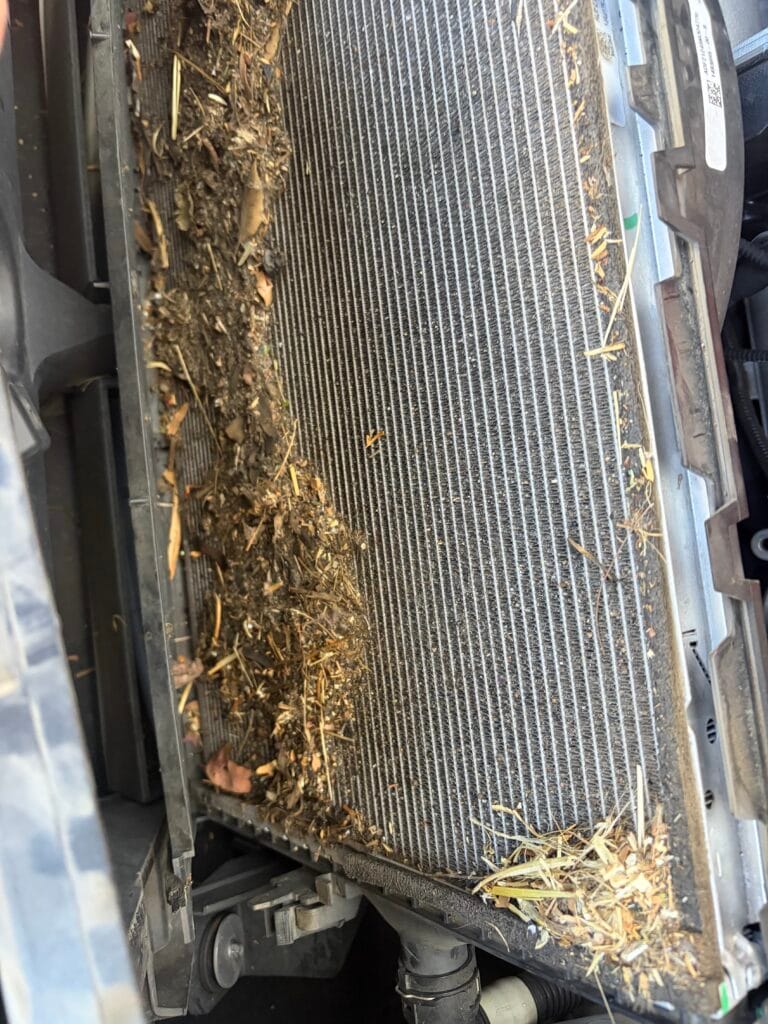
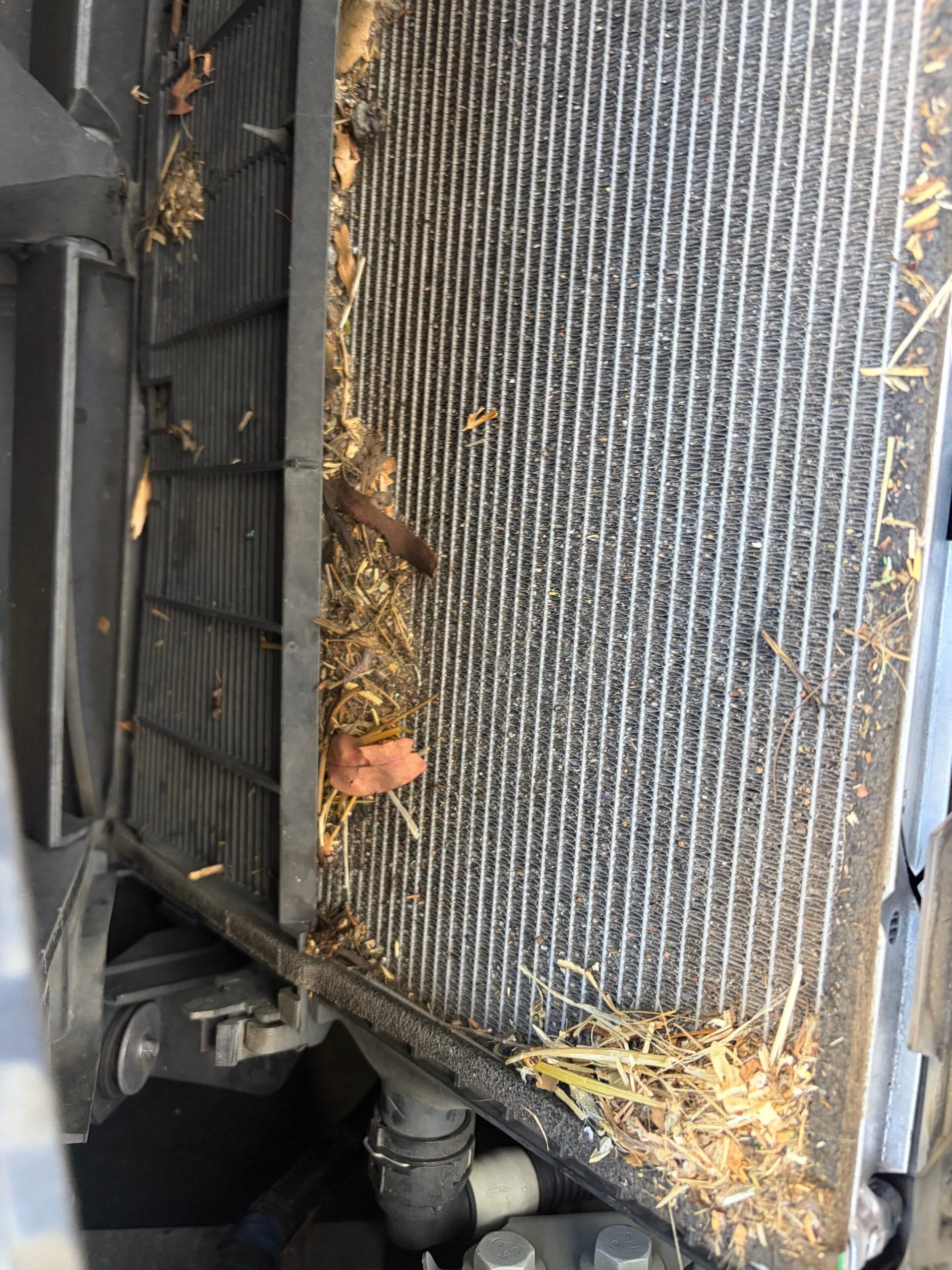
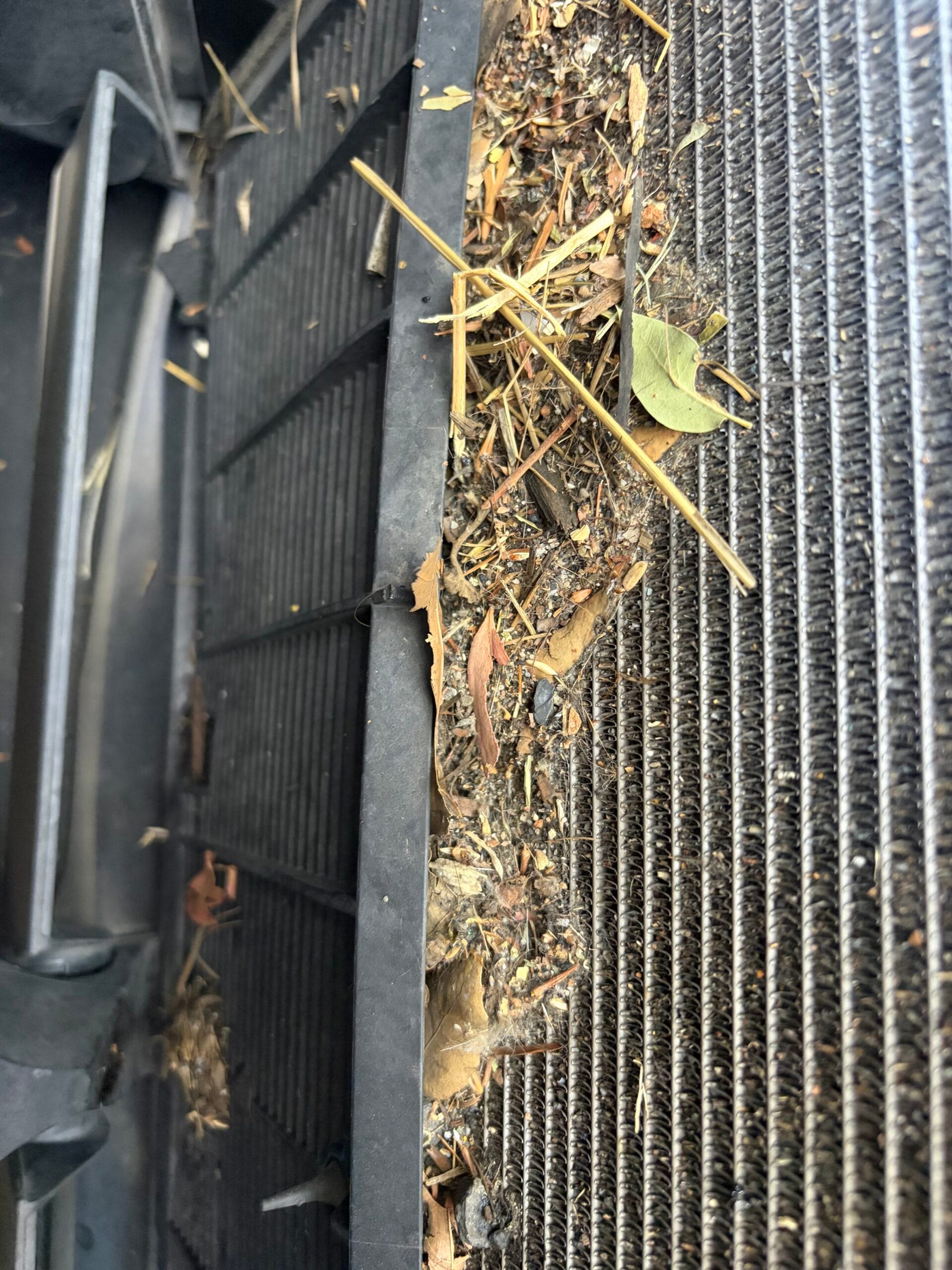
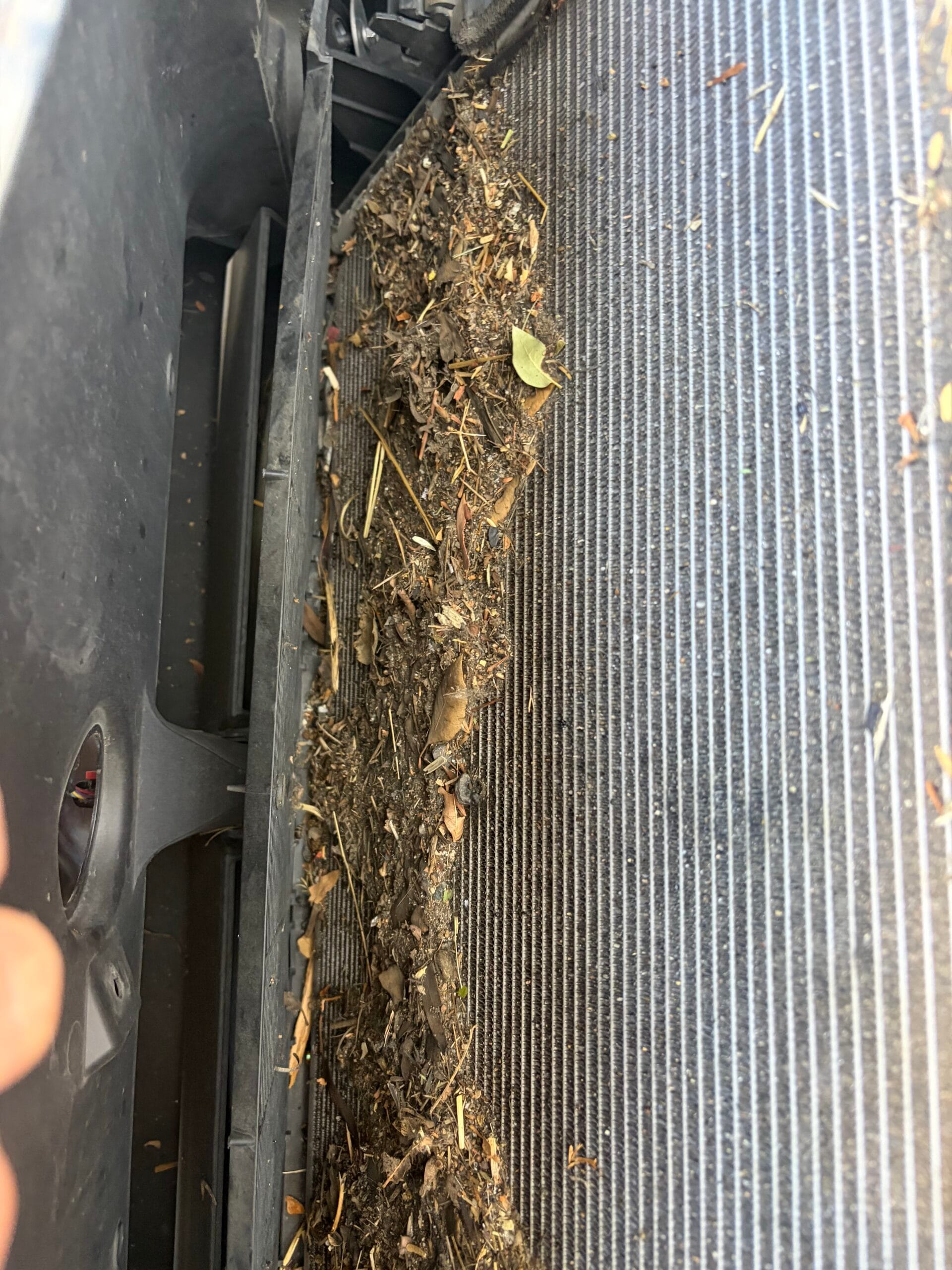
Tesla’s front cooling stack layers the AC condenser directly in front of the main radiator. Leaves, pine needles, dry grass, and road dust collect in the gap between them over time. Sacramento’s oak trees and dry summer air make this one of the most common Tesla issues we see here.
Unlike a traditional car where the radiator just cools the engine, Tesla’s system uses the same cooling stack to manage the battery, cabin AC, powertrain, and charger — all routed through an Octovalve-controlled coolant loop. When the condenser face is blocked, airflow drops across the whole system.
Tesla monitors this in real time. In Service Mode, the car reports “Radiator Health %” — a direct measure of cooling efficiency. When it drops (we’ve seen cars come in at 62% and lower), the BMS responds by:
- Flagging a “Speed Limited” message on the touchscreen
- Surfacing multiple system alerts
- Reducing fan effectiveness (the fan can’t compensate for a physical blockage)
- Throttling AC output to protect the compressor
- Reducing Supercharging speed in hot weather
Warning Signs to Watch For
- “Speed Limited” warning with no obvious cause
- 3 or more thermal-related alerts
- AC blowing less cold than it used to, especially on 95°F+ days
- Radiator Health below 100% in Service Mode
- Louder-than-usual cooling fan noise
- Reduced charge speed at Superchargers in summer
Why It Can’t Wait
A partially blocked condenser forces the AC compressor to work harder than it was designed to. If the blockage is left long enough, the compressor can fail — Tesla owner forums regularly report $4,000+ in repair costs from ignored condenser blockage. A cleaning is a fraction of that.
What We Do
- Remove the active grille shutter to access the condenser-radiator stack
- Extract packed debris from the condenser-to-radiator gap (leaves, pine needles, dirt — it can be a lot)
- Clean the fin faces with compressed air, working carefully to avoid bending fins
- Reassemble and verify in Service Mode that Radiator Health returns to 100% and fan RPM is normal
- Clear any thermal-related alerts and confirm no underlying damage
The whole process typically takes 1–2 hours.
Sacramento Summers Don’t Forgive a Blocked Condenser
When ambient temps hit 100°F+, your Tesla’s thermal system has almost no margin left. A condenser running at 62% efficiency in June heat is a condenser that’s one long drive away from a “Speed Limited” message on I-5. We clean these before that happens, and after.
Book Your Cleaning
Call (916) 957-6884 or use our contact form to schedule. AT Automotive, 8561 Weyand Ave, Sacramento, CA 95828. Mon–Fri 10am–5pm.
For other Tesla services — battery diagnostics, brakes, suspension, coolant — see our independent Tesla repair Sacramento page.
Our Warranty
Every repair at AT Automotive is backed by a 12-month / 12,000-mile warranty on parts and labor.
Related Services
You might also need: Tesla AC not blowing cold · Tesla musty AC smell fix · why Teslas say Speed Limited.
Frequently Asked Questions
Why is my Tesla showing Speed Limited?
The most common cause is a clogged condenser or radiator. Leaves, pine needles, and organic debris pack between the condenser and radiator fins, blocking airflow. When the battery can’t cool properly, Tesla limits power and speed to protect it.
How much does Tesla condenser cleaning cost in Sacramento?
AT Automotive charges a straightforward fee for Tesla condenser and radiator cleaning. Contact us for current pricing — we’re transparent about costs upfront.
How long does Tesla condenser cleaning take?
Most condenser cleaning jobs take 1–2 hours. We remove the frunk components, carefully clean the fins, clear the drain paths, and reassemble.
Will cleaning the condenser fix my Tesla’s Speed Limited warning?
If the warning is caused by blocked airflow — which it is in the majority of cases — yes. We’ve resolved Speed Limited warnings on dozens of Tesla Model 3 and Y vehicles through condenser cleaning alone.