
Your Tesla’s AC blows warm air while you’re sitting at a red light. The fan sounds like it’s working overtime. Get on the highway and suddenly the AC is fine again. This is one of the most common complaints we hear from Tesla Model 3 and Model Y owners in Sacramento — and the good news is it’s usually not an expensive fix.
Why This Happens on Model 3 and Model Y
When your Tesla is moving at highway speed, air rams through the front cooling stack whether the fan is working or not. At a standstill or in slow traffic, your car relies entirely on the condenser fan to push air through the AC condenser and radiator. If that airflow is reduced — either because the condenser is clogged with debris or because the fan itself is weak — cooling drops off fast. Move faster, and the problem seems to go away.
There are two main culprits, and we diagnose which one (or both) you’re dealing with before recommending anything:
1. Clogged Condenser
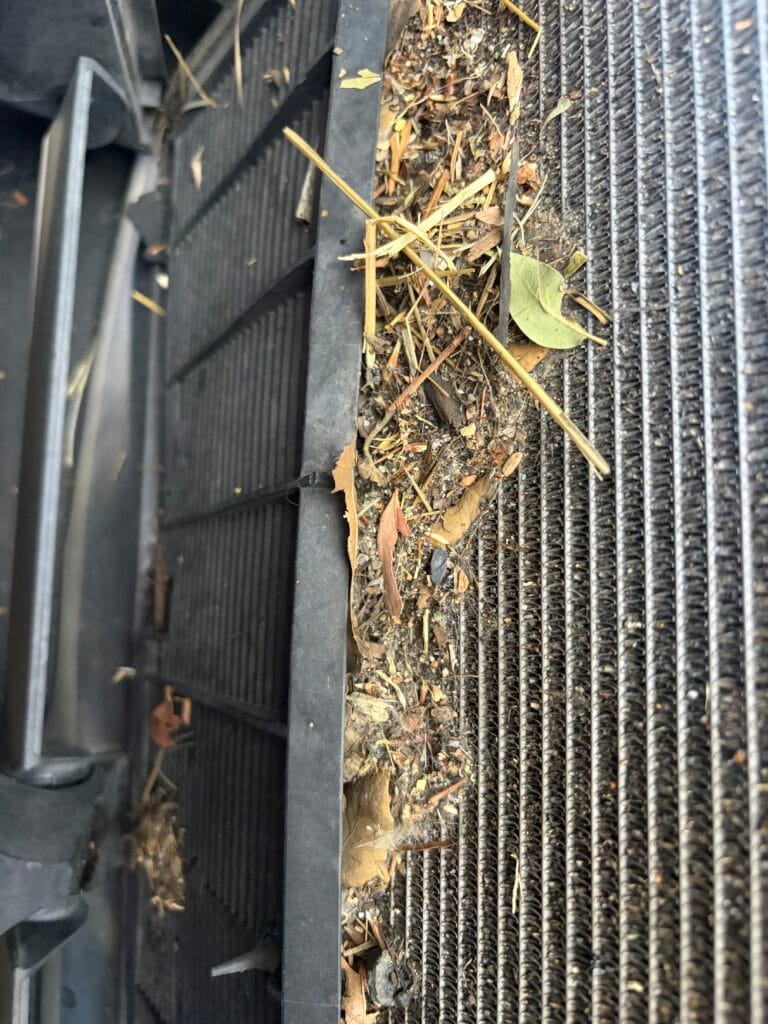
The AC condenser on the Model 3 and Y sits at a slant due to the car’s aerodynamic nose design. This means leaves, pine needles, road dust, and dry grass collect in the gap between the condenser and the radiator behind it — and Sacramento’s oak trees and dry summer air make it worse than most climates. A packed condenser blocks airflow, starves the AC system, and makes the fan run harder to compensate. Cleaning it often solves the problem completely.
2. Weak or Failing Condenser Fan
On 2020+ Model 3 and all Model Y vehicles (which use a heat pump), the condenser fan motor is a known wear item. A fan that’s losing power won’t move enough air at idle even if the condenser is clean. Signs include: louder-than-normal fan noise, grinding or buzzing from the front of the car, and AC that struggles specifically when stopped. Tesla has issued both a recall (22-V-063) and a service bulletin (TSB SB-21-18-002) related to HVAC fan and sensor failures on these vehicles.
What We Check
- Pull up Service Mode to check fan RPM, condenser status, and refrigerant pressure in real time
- Inspect the condenser for debris — clean it if blocked, verify cooling improves
- Test the condenser fan at full speed and measure output vs. spec
- Check for open recalls or applicable software updates (22-V-063)
- Inspect refrigerant charge if fan and condenser check out clean
We don’t guess and replace. We diagnose first, so you’re not paying for parts you don’t need.
Warning Signs You Shouldn’t Ignore
- AC blows warm air at red lights or in slow traffic
- AC improves noticeably once you reach 40–50 mph
- Loud fan noise or grinding from the front of the car
- AC compressor sounds like it’s running constantly and loudly
- “Speed Limited” warning in hot weather
- Cabin temps climbing even with AC set to max
Left unchecked, a failing condenser fan forces the AC compressor to work beyond its design limits. We’ve seen compressor failures in vehicles that ignored this for multiple summer seasons — those repairs run $3,000–$4,000+. A fan replacement or condenser cleaning is a fraction of that.
Sacramento Summers Don’t Leave Room for a Weak AC System
When outside temps are 100–105°F in July and August, your Tesla’s entire thermal management system — battery, powertrain, and cabin — runs near its ceiling. A 30% drop in condenser airflow at a Sacramento summer stoplight isn’t a minor inconvenience. It’s how thermal events and compressor failures start.
Book a Diagnosis
Call (916) 957-6884 or use our contact form. AT Automotive, 8561 Weyand Ave, Sacramento, CA 95828. Mon–Fri 10am–5pm.
We also service Tesla condenser blockage (see our Tesla condenser cleaning page) and handle all other Tesla work — see our independent Tesla repair Sacramento page for the full list.
Our Warranty
Every repair at AT Automotive is backed by a 12-month / 12,000-mile warranty on parts and labor.