You pull into a parking spot, turn the wheel, and hear it: a creak from the front of the car, like an old door hinge. Or maybe it’s a clunk every time you go over a speed bump. If you drive a Tesla Model 3 or Model Y, you’re far from the only one. Front suspension noise is one of the most common complaints on these cars.
The Usual Suspect: The Front Upper Control Arm
Most of the time, the noise is coming from the front upper control arm. Each arm has a ball joint that’s sealed to keep water and dirt out. Over time, water can get past that seal. Once it’s inside, the joint loses its lubrication and starts to wear.
It usually starts as a creak or squeak when you turn at low speed: parking lots, driveways, tight turns. Left alone, the wear gets worse and the creak can turn into a clunk.
Why You Can’t Just Replace the Ball Joint
On many cars, a worn ball joint can be pressed out and replaced on its own. On the Model 3 and Y, the ball joint is built into the upper control arm. So the fix is replacing the whole arm. Tesla has put out a service bulletin on the problem and revised arms are available.
Since both front arms see the same weather and road conditions, when one starts creaking the other usually isn’t far behind. Replacing both together often saves you a second trip.
It’s Not Always the Upper Arm
Other parts can make similar sounds. Worn lower control arm bushings can clunk. Worn struts can knock over bumps and make the ride feel bouncy. Loose or worn links can rattle. That’s why the first step should always be a proper inspection on a lift, checking each joint for play, rather than guessing and replacing parts until the noise stops.
Is It Safe to Keep Driving?
A light creak is usually a wear warning, not an emergency. But worn suspension joints don’t get better on their own. As they wear, they can affect how the car handles and how fast your front tires wear out. If you notice a clunk, the steering feels looser than it used to, or the car feels less stable on the freeway, get it checked soon.
A Separate Issue: The 2026 NHTSA Investigation
There’s also a more serious, separate issue in the news. In July 2026, NHTSA opened an investigation into about 1.2 million 2018–2020 Model 3 and 2021–2023 Model Y vehicles over front lower lateral links coming loose, sometimes without warning. It isn’t a recall, but if one of those cars starts clunking from the front, don’t wait. Get it inspected, and check your VIN at nhtsa.gov/recalls.
What About Warranty?
If your car is still under Tesla’s basic warranty, suspension parts are covered, so check with Tesla first. If you’re out of warranty, an independent shop that works on Teslas can do the same repair, usually with a shorter wait than a service center appointment.
Get It Checked in Sacramento
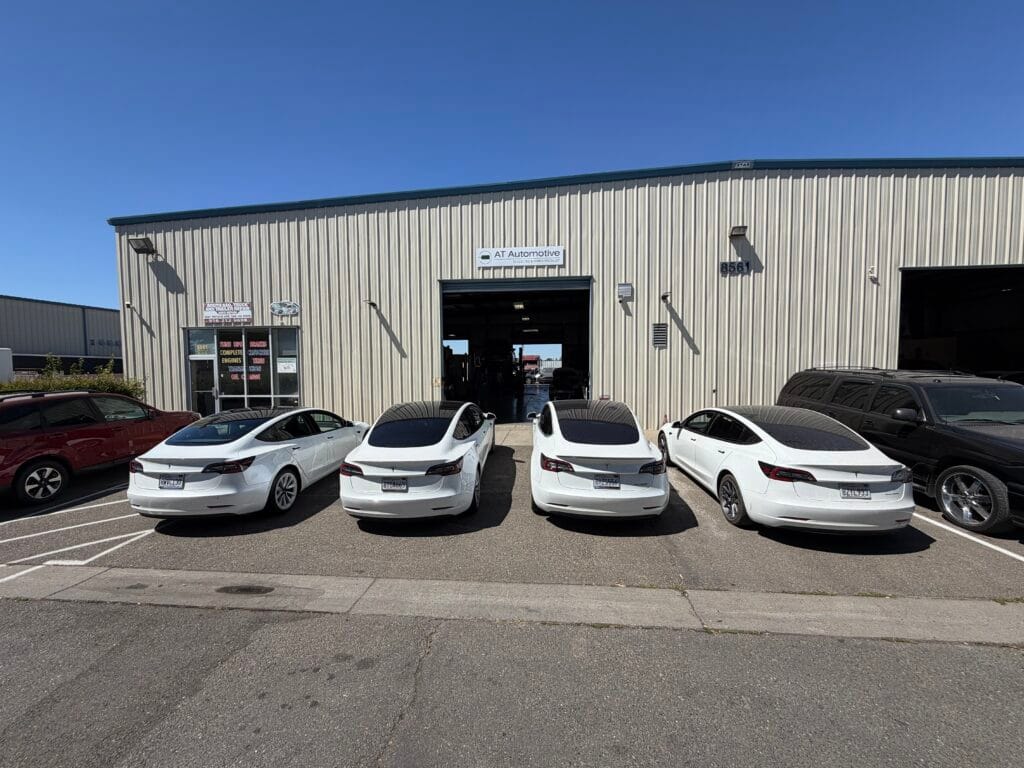
AT Automotive works on Teslas every day, including upper and lower control arms and struts and shocks on the Model 3 and Model Y. We’ll find what’s actually making the noise and give you an upfront quote before doing any work.
Model-specific details, including year-by-year problems and recalls, are on our Tesla Model 3 suspension repair and Tesla Model Y suspension repair pages.